The Global Slavery Index report is published by the Walk Free Foundation (“Walk Free”). Walk Free is committed to ending all forms of modern slavery in this generation.
The Global Slavery Index provides a ranking of 162 countries, reflecting a combined measure of three factors: estimated prevalence of modern slavery by population, a measure of child marriage, and a measure of human trafficking in and out of a country. The measure is heavily weighted to reflect the first factor, prevalence. A number one ranking is the worst, 162 is the best.
Modern slavery includes slavery, slavery-like practices (such as debt bondage, forced marriage and sale or exploitation of children), human trafficking and forced labour, and other practices described in key international treaties, voluntarily ratified nearly every country in the world.*
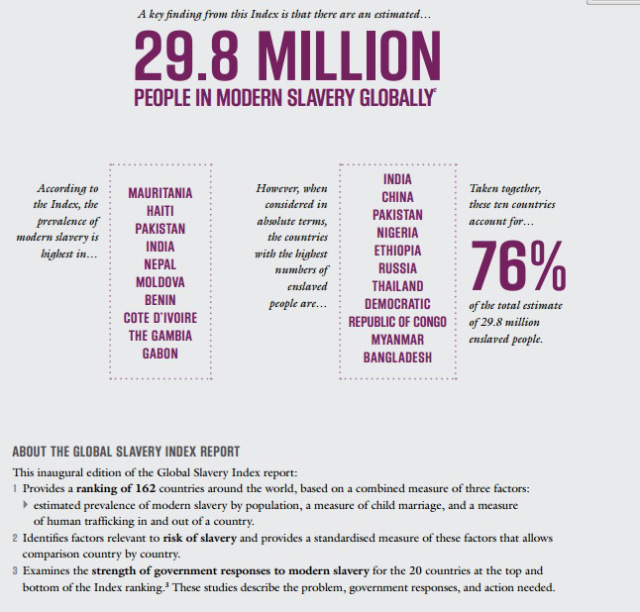
The Global Slavery Index 2013 defines slavery as the possession or control of people to deny freedom and exploit them for profit or sex, usually through violence, coercion or deception. The definition includes indentured servitude, forced marriage and the abduction of children to serve in wars.
The countries with the highest numbers of enslaved people are India, China, Pakistan, Nigeria, Ethiopia, Russia, Thailand, Democratic Republic of Congo, Myanmar and Bangladesh. Taken together, these countries account for 76% of the total estimate of 29.8 million in modern slavery.
At the other end of the scale, Iceland has the lowest estimated prevalence with fewer than 100 slaves.
Next best are Ireland, Britain, New Zealand, Switzerland, Sweden, Norway, Luxembourg, Finland and Denmark, although researchers said slave numbers in such wealthy countries were higher than previously thought.
TURKEY
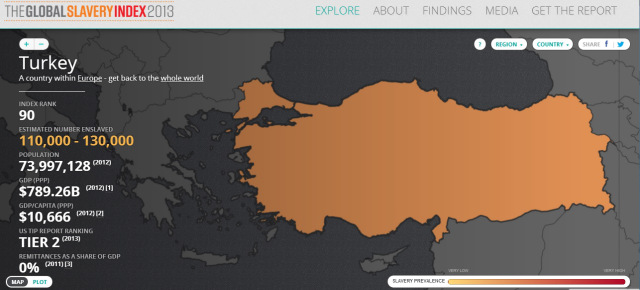
The report, the first Global Slavery Index to be produced by the foundation, puts Turkey at number 90 of the 162 included on the list.
The report establishes that the number of people forced into marriage in Turkey, forced to live with someone due to a debt, or victims of human trafficking number around 130,000, meaning that one out of every 570 people is living in slavery.* Key definitions are located in: 1926 Convention to Suppress the Slave Trade and Slavery; the 1957 Supplementary Convention on the Abolition of Slavery, the Slave Trade and Institutions and Practices Similar to Slavery; the ILO Convention Concerning Forced or Compulsory Labour; and the Protocol to Prevent, Suppress and Punish Trafficking in Persons, especially Women and Children, supplementing the United Nations Convention against Transnational Organized Crime.
Full Report : The Global Slavery Index 2013



 CHP EU Representation - Brussels